
The Enrollment Funnel Nobody Talks ABout
There's a meeting that happens in districts across the country every January. Someone pulls up the enrollment numbers, the room gets quiet, and the question nobody wants to answer hangs in the air: Where did we lose them?
The answer, almost always, is: everywhere. But not in the ways most districts are looking for.
The real problem isn't your open enrollment process. It's that you've been treating enrollment as an event when families experience it as a journey. That journey often starts 12 to 18 months before they ever fill out a form.
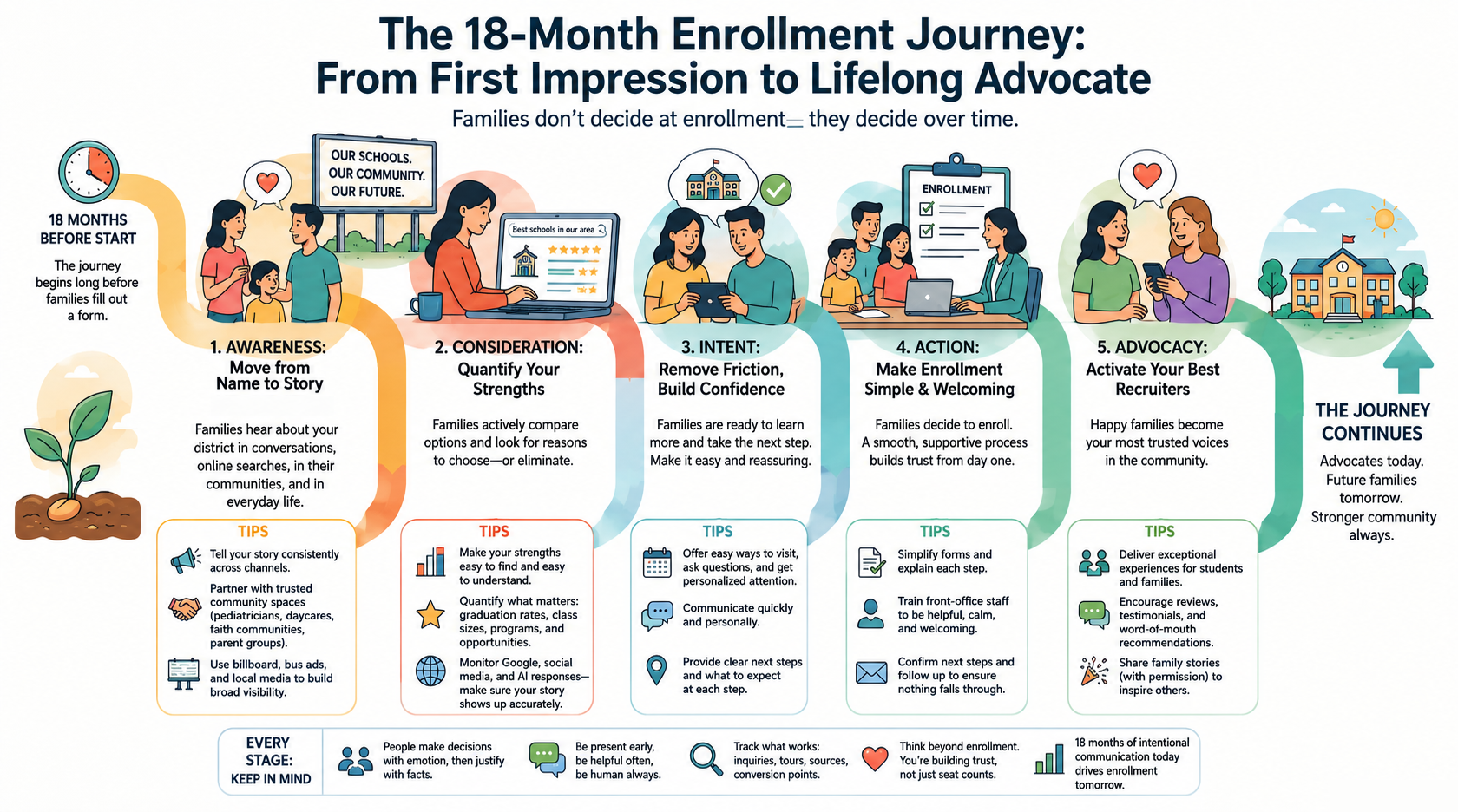
Enrollment decisions don’t begin with an application. They begin with conversations, impressions, and trust built long before families ever fill out a form.
The Journey Has Already Started (Without You)
Picture a family at a birthday party in February. Their kid is four. Another parent mentions offhand that they've heard great things about a school across town. Nobody pulls out a brochure. Nobody visits a website. But a seed gets planted.
By the time that family is actively researching schools, whether its comparing options, attending tours, or asking neighbors. That means most of their impressions are already formed. They've made soft decisions. They have favorites and dealbreakers. And if your district hasn't shown up yet in their world, you're playing catch-up against schools that have.
This journey is more complicated than ever. Families don't just ask friends anymore. They ask AI. What ChatGPT or Gemini say about your district matters now in ways that didn't exist two years ago. The research phase is more decentralized, more algorithmic, and more influenced by ambient signals. Google review from three years ago, a Facebook post someone shared, a billboard they drove past twice—these matter as much as any single piece of content you carefully crafted.
If you want to meet families where they are, you need a map of where they go.
Borrowing from Marketing (Unapologetically)
The marketing world has a concept called the customer journey funnel: a framework that maps how someone moves from never having heard of you to becoming a paying customer who tells their friends. The stages are usually some version of Awareness → Consideration → Intent → Action → Advocacy.
Communications professionals in education don't often wear a marketer-first hat, and for good reason. The role is so much bigger. You're building community trust, navigating politics, supporting crisis response, and serving families across wildly different circumstances. You're not selling a product; you're serving a public.
But that doesn't mean there's nothing to learn here. The funnel isn't about manipulation. It's about meeting people where they are with the right message, at the right time, through the right channel. That's simply good communication that applies to enrollment as much as it applies to anything else.
Let's walk through each stage.
Awareness: Do Families Even Know Your School Exists?
Most public districts have a built-in awareness advantage private schools don't: families generally know their neighborhood school exists. But awareness of existence and awareness of what makes you different are two very different things. The latter is almost always the weakest stage for districts.
The question isn't just "Do they know our name?" It's "Do they know our story?"
Start with your 12-month communications calendar. Not every piece of content you publish is seen only by enrolled families. Parents share things. Posts get forwarded. A first-grade teacher's back-to-school video ends up in a mom group full of parents with kids who are two years away from kindergarten. You don't need a separate "prospective family" content track (year-round, at least), but you should be conscious that your audience is broader than your enrollment roster. Occasionally speak to those quiet followers who are watching but haven't committed.
For kindergarten enrollment specifically, your best partners aren't other schools. They're pediatric offices, daycares, faith communities, and parent groups. These are the places families trust before they trust you. A flyer in a waiting room. A mention from a childcare director. A warm word from a pastor. These touch points plant seeds in the awareness stage without feeling like recruitment.
For families with older children, awareness is more competitive. Comparison messaging, even without naming competitors, can do real work at this stage. A well-placed billboard that highlights something your district does exceptionally well (graduation rates, dual-enrollment options, arts programming, whatever your genuine strength is) doesn't need to say "better than the school down the road." Families fill in that blank themselves.
Consideration: What Does the Side-by-Side Look Like?
When a family is actively comparing two or three schools, they're not looking for general information anymore. They're looking for reasons to choose or eliminate. This is where vague messaging costs you and clarity wins.
Your brand visibility matters enormously here. It matters not just on your own website, but everywhere families look. That includes Google search results, social media, and increasingly, AI-generated answers. When someone types "best schools in [your city]" into ChatGPT or asks Gemini to compare options, what comes back? Do you show up? Is what's out there accurate and representative of your strengths?
Quantify your strengths and say them loudly. Don't make families dig for your 94% graduation rate or your 11:1 student-teacher ratio or your award-winning CTE program. Put the numbers front and center, in plain language, across multiple channels. Specificity builds credibility. Generalities get scrolled past.
Touchpoints matter more than you think. Here's a scenario: a family calls to ask about enrollment. They reach the building secretary, who is kind but harried and gives them a date and a form number. They come in for a tour led by whoever happened to be available. They leave without hearing from anyone for two weeks.
Now here's another scenario: they receive a warm email before the tour that tells them what to expect, who they'll meet, and invites them to send questions in advance. During the tour, a teacher stops to introduce herself and share something specific about the program. A week later, they get a personal follow-up thanking them for coming and answering the question they asked about the lunch program.
Same school. Completely different experience. And the second family tells people about it.
Intent: They've Decided to Learn More. Now What?
Intent is a delicate stage. A family who reaches out is telling you something important: they're serious. How you respond shapes everything that follows.
Your inquiry form is more powerful than most districts realize. Most use it as a data collection tool. That’s great, but it's also your first opportunity to personalize the experience. What do you actually need to know to give this family a great tour? What's their child interested in? Do they have specific questions? Are there circumstances you should be aware of? Asking the right questions upfront means every subsequent touchpoint can be more relevant.
Feedback loops are underused in this stage. Families often don't know what to ask, and staff leading tours don't always know what families are actually wondering. The result is a tour that hits all the standard stops but misses what actually matters to this particular family. Build in structured moments: a simple question before or during the visit, or an invitation to share what they're still uncertain about. That opens up the conversation. When families are encouraged to ask, and you answer with something specific and compelling, vanilla tours become memorable ones.
Action: Can They Actually Complete Enrollment?
This is the stage where districts most often get in their own way.
Some friction is unavoidable. Required documentation is just that: required. Legal and regulatory constraints are real. But the experience of completing enrollment, from how it's sequenced, how it's communicated, and how intuitive it is, is almost entirely within your control.
From the moment of first inquiry, share the roadmap. A simple checklist of what enrollment involves, sent early, reduces anxiety and sets expectations. Better yet, if you've gathered information through your inquiry process, pre-populate what you can. Reducing the number of steps a family has to repeat is a small thing that signals big care.
Your website's enrollment experience deserves real investment. We’re not talking about a design refresh, but a usability audit. Test it with real families (willing ones. Send a gift card, ask for 30 minutes). Watch where they hesitate. Watch what they can't find. The number of districts where "how to enroll" requires three clicks and a phone call to answer is stunning. It should be the most obvious thing on your site.
Advocacy: Your Best Recruiters Are Already Enrolled
Happy families are a communications asset most districts dramatically underuse.
Word of mouth has always been the most powerful enrollment tool. However, the pathways for word of mouth have multiplied. A parent who leaves a thoughtful Google review, shares a post from your school's social account, or sends a personal recommendation to a neighbor is doing recruitment work you could never replicate with a paid campaign.
Make it easy for families to share publicly. Not pushy, just easy. A well-timed ask after a positive experience (a great concert, a strong parent-teacher conference, an exceptional field trip) lands very differently than a generic "leave us a review" email. Create natural moments.
Engage families on public channels. When a family tags your school in a post, respond. When a parent shares something proud, amplify it. The families who see those interactions are watching how you show up.
Gather testimonials, and actually use them. Not just on a buried page called "Testimonials" that no one visits. Woven into tour materials. Incorporated into social content. Featured on your homepage. Real voices from real families carry weight that institutional messaging never will.
Quick Audit: Where Are You Losing Families?
Every district has a weakest link in this chain. A quick way to find yours: trace the journey of your last 10 enrollment inquiries backward.
How did each family first hear about you? (Awareness)
What did they compare you to, and what tipped the scale? (Consideration)
What was their first contact experience like? (Intent)
How long did enrollment take, and where did people stall? (Action)
How many enrolled families have left a review or referred someone in the last year? (Advocacy)
Where you see drop-off, confusion, or silence is your weakest link. If you’re having trouble identifying what to tackle first, ask! Families will appreciate your openness, and you’ll learn something.
The Communications Implication
Here's the principle that ties all of this together: your messaging, channels, and timing should match where families are in their journey, not where you want them to be.
A family who just moved to town and is vaguely curious doesn't need your enrollment deadline. A family who has been following you for months and toured last week doesn't need a brand awareness post. The right message to the wrong person at the wrong time is not helpful and it can feel irrelevant or even tone-deaf.
The enrollment funnel isn't a marketing trick. It's a way of seeing your audience more clearly, and communicating with them more humanly. When you meet families where they actually are you don't just enroll them, you earn them.
