
Building Your K-12 Communications Calendar
There's a version of this job that feels like whack-a-mole.
A principal texts you Monday morning: “Can you get something out about the book fair this week?” A teacher emails Wednesday asking if you can post about her classroom supply drive. Thursday, you find out the board meeting agenda changed and the letter you sent home Tuesday is now partially wrong. Friday, you're starting from scratch on next week's newsletter because nothing was planned and there's nothing obviously ready to write about.
This is reactive communications. It is exhausting, it produces inconsistent work, and it makes you look disorganized to the people watching. Given the amount of resources you touch on a given week, a lot of people are watching.
A communications calendar doesn't fix everything. But it fixes this.
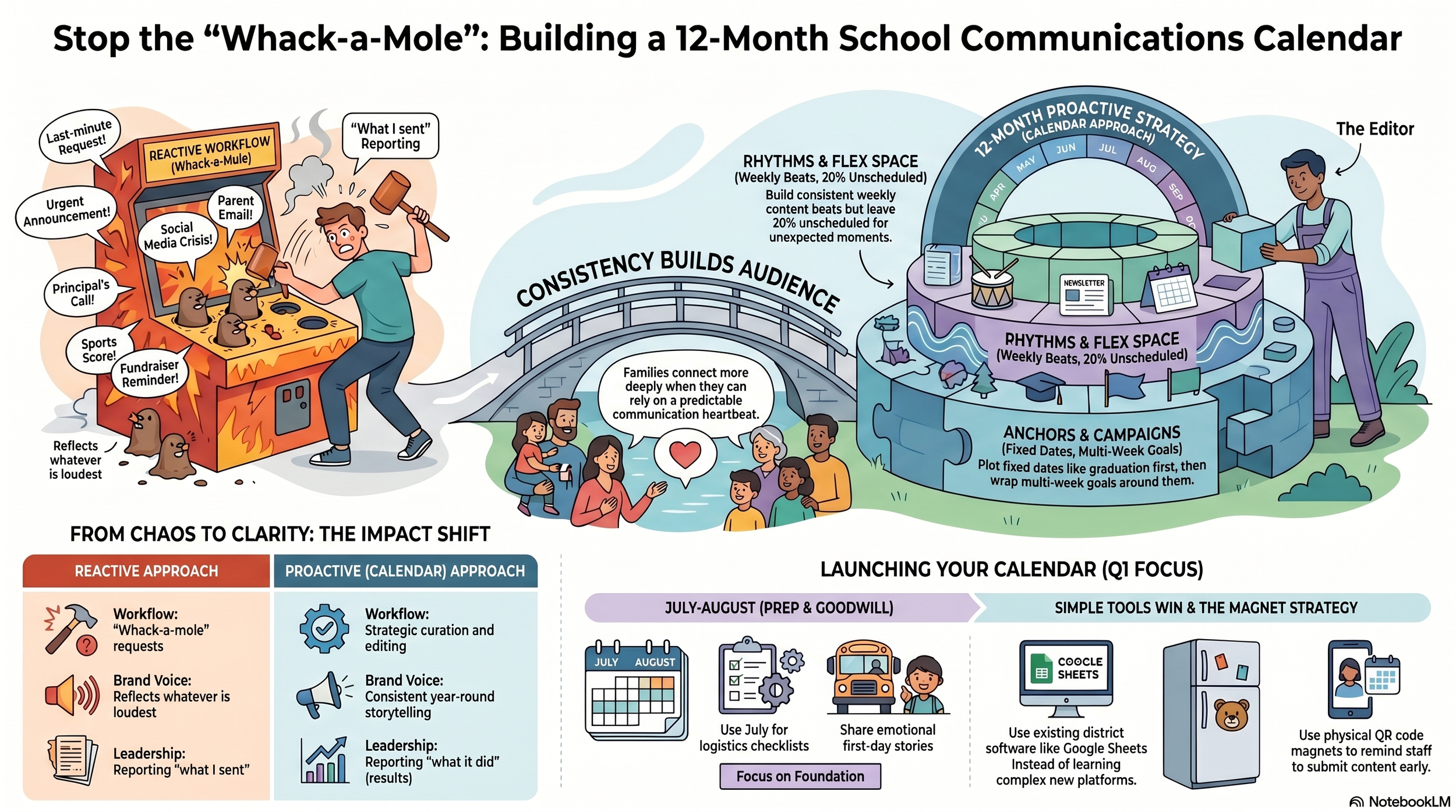
Stop reacting and start leading your district’s story on a clear rhythm that builds trust, consistency, and real momentum year-round.
Why the calendar matters more than you think
The obvious benefit of a communications calendar is that it keeps you organized. That's true, but it undersells what a calendar actually does for you and your district.
It keeps your brand consistent year-round. When you're planning reactively, the content that goes out reflects whatever is loudest that week: a principal's ask, a board directive, or a crisis. When you're planning ahead, you can ensure that your district's story is being told steadily and intentionally across every month of the year. The fall newsletter doesn't accidentally feel like a completely different district than the spring one. The social media feed in January doesn't look abandoned because the holidays are over and nobody planned what came next.
It creates the internal communications flow you desperately need. Here's something nobody tells you when you start this job: your ability to do your work well depends almost entirely on other people giving you information in time for you to do something with it. The principal who tells you about the award-winning student on the day of the assembly. The athletic director who sends you the game schedule two days before the season starts. The teacher who wants something in the newsletter that goes out in four hours.
A calendar gives you the structure to pull those people forward. When your submission deadlines are published, shared ahead of time and followed up on, you stop chasing and start curating. You become the editor, not the errand runner.
It gives you something to measure and report on. One-off campaigns are hard to learn from. Did the enrollment push work? Compared to what? When your communications are planned in advance and tied to goals, you can track results over time, identify what's moving the needle, and show leadership a body of work. That shift from "here's what I sent" to "here's what it did" is how communicators earn more authority, budget, and trust.
The four layers of a communications calendar
A school communications calendar isn't just a list of what to post when. It has four distinct layers, and each one does different work.
Layer 1: Institutional anchors. These are the dates that exist whether you plan for them or not: enrollment deadlines, board meeting dates, testing windows, state report card releases, spring sports seasons, graduation, back to school, and more. Plot these first, in a dedicated color. Everything else you plan will wrap around them. These are also the dates that tend to create reactive chaos when communicators don't see them coming.
Layer 2: Campaign windows. Enrollment push. Bond or levy campaign. Budget season. Start-of-year brand building. These are your intentional, multi-week communication efforts with a defined goal, audience, and outcome. Mark their start and end dates. Give each campaign enough runway as most districts dramatically underestimate how early campaign communications need to start to actually move people.
Layer 3: Content rhythms. Your weekly newsletter. Monthly social media themes. Quarterly parent surveys or feedback touchpoints. These are the recurring content structures that give your communications a reliable heartbeat. Families who know a newsletter comes every Tuesday morning (and it's worth reading!) are families who are more connected to the district. Consistency builds audience. Build your rhythms and protect them.
Layer 4: Flex space. Leave 20% of your weeks unscheduled. Not because you'll run out of things to say, but because schools are unpredictable. A student will do something remarkable. A community event will emerge. A crisis will require your full attention for a week. Flex space means those moments get handled with care instead of stress, and your planned content doesn't get thrown into chaos every time life intervenes.
The tool is not the point
Before we talk about what goes in your calendar, let's address the tool question, because it is a trap communicators fall into constantly.
You do not need special software to build a communications calendar. A Google Sheet works. A shared Notion board works. A whiteboard in your office works. What doesn't work is spending two weeks evaluating project management platforms while your communications remain unplanned.
More importantly: build your calendar in whatever tool your colleagues already use. If your district runs on Google Workspace, your calendar lives in Google Sheets. If your principals live in their email and nothing else, your calendar's submission system needs to reach them through email. Don't ask other staff members to learn a new system to participate in your planning process. More times than not they won't adapt, and you'll end up managing the tool instead of the content.
Make it easy for people to feed you information. Build a simple content submission form where teachers, principals, and program coordinators can submit upcoming events, student achievements, and content requests on a rolling basis. Give them the link. Remind them about it. Then do something unusual: make it physical.
When working with a district last year, we printed QR codes linking to the content submission form and had them made into small magnets. Every teacher had one on their desk before they came back in the fall. Submissions went up immediately. People don't ignore a form because they don't care, they ignore it because they forget. A magnet on a desk doesn't let them forget.
Built specifically for school communications teams, this isn’t just a spreadsheet. It’s a full-year planning system designed to help you move from scrambling to strategic.
We offer this tool through a “pay what you want” model. Choose your price, or take it for free!
Building Q1 from scratch
Most schools we have worked with operate on a July-June fiscal year. Here's what a planned Q1 looks like on a real calendar.
July: Final enrollment push and back-to-school preparation. Enrollment season is either wrapping up or in its final push. If you have any late-enrollment families on your radar, July is your last real window to reach them. At the same time, you're building the content infrastructure for back to school: the communications that will go out in August need to be drafted now, not the week before school starts.
Back-to-school communications are deceptively complex. You're the central source for information that families across multiple buildings need at the same time, and they're asking all of it at once: What time does school start? Where does my kid get dropped off? What's on the supply list? Which bus are they on? Which forms are still missing? Each building may have slightly different answers, and your job is to make sure families get the right information without drowning in twelve different PDFs from twelve different principals.
Build a back-to-school communications checklist in July. Map every question a new or returning family might ask. Assign a source for each answer. Set your deadline to have all of it in hand before August begins.
August: Back to school, first impressions, and early social proof. The newsletter is running. The social channels are active. But beyond logistics, August is your first real opportunity to show the community who your district is this year. Pre- and early-school-year content like teachers setting up classrooms, messages from staff expressing excitement to get started, principals greeting students on the first day, or kids getting off buses with backpacks bigger than they are costs almost nothing to produce and does enormous work for your brand.
Parents who are nervous about a new school year are watching your social channels in August. What they see shapes how they'll feel about communications from you for the rest of the year. Earn that goodwill in the first two weeks of school.
September: Settle into rhythms and get ahead of fall. Your content rhythms are running. Athletics have started, which means event coverage, score updates, and athlete spotlights are in the queue. Before you know it, homecoming season is on the horizon. This and other content-rich, community-building moments deserve more planning than a last-minute Instagram caption. A strong calendar helps make that possible.
September is also the right time to survey your internal sources. How is the submission form working? Which principals are consistently sending you content and which are silent? Now is the time to build those relationships.
The mistakes that will derail you
Planning content before you've plotted your anchors. It seems like a small thing, but it causes real problems. If you don't know when state report cards drop before you build your fall content plan, you'll have a newsletter calendar full of evergreen content and no room for the most significant district communications moment of the season. Always anchor first. Content fills the space between anchors.
Not getting principal buy-in on shared dates. Your calendar is only as accurate as the information you have. If a principal changes the schedule of a major event and you find out the day before, that's a calendar problem. Specifically, it’s a problem of insufficient buy-in from the people who control the information. Share your calendar with building principals before it's final. Ask them to flag conflicts. Build the habit of treating your calendar as a shared document, not a unilateral communications plan. Then review it together weekly (you’ve built in a standing time with your admins each week, right?)
Treating the calendar as static. Your calendar should be reviewed and adjusted monthly. Not rebuilt from scratch, but genuinely interrogated: what's coming up that wasn't on the radar? What campaign is underperforming and needs a different approach? What content theme fell flat and should be replaced?
When you bring results to leadership (whether they're wins or misses), don't just report the number. Bring a plan. A high open rate on last month's newsletter deserves a conversation about how to build on that momentum. A low-engagement social campaign deserves a hypothesis about why and a proposed adjustment. Communicators who show up with analysis and a plan build far more credibility than those who show up with a spreadsheet of metrics and a shrug.
The calendar isn't a document you make in July and revisit in June. It's a living tool. Treat it that way, and it will protect your time, strengthen your brand, and give you the standing to do the rest of your job well.
